Where the nickname comes from
History's true Spice Islands are the Malukus in Indonesia, birthplace of the clove tree. Zanzibar inherited the title in the nineteenth century, when clove growing was imposed on a large scale by Sultan Seyyid Said. By the 1840s the archipelago supplied roughly three quarters of the cloves traded worldwide.
The sultan is said to have decreed that a set number of clove trees be planted for every coconut palm. Sources disagree on the exact figure, but the effect is not in doubt: the island filled with plantations within a few decades.
What grows today
- Cloves, still the main commercial crop. The flower bud is picked before it opens, then sun-dried.
- Cinnamon, whose bark is peeled from young branches; it curls as it dries.
- Nutmeg, hidden inside a fruit whose bright red aril yields mace.
- Cardamom, black pepper, turmeric, ginger, lemongrass and pandan.
- Vanilla, expanding, grown as a vine on supports.
Pemba produces more cloves today than Unguja. That is the direct legacy of the 1872 hurricane, which destroyed most of the main island's clove trees.
The plantation visit
The farms open to visitors are concentrated around Kizimbani and Kidichi, inland north-east of Stone Town. The format is much the same everywhere: a guided walk through the plantation, crushing, scratching and smelling the plants, a fruit tasting, and often a Swahili lunch.
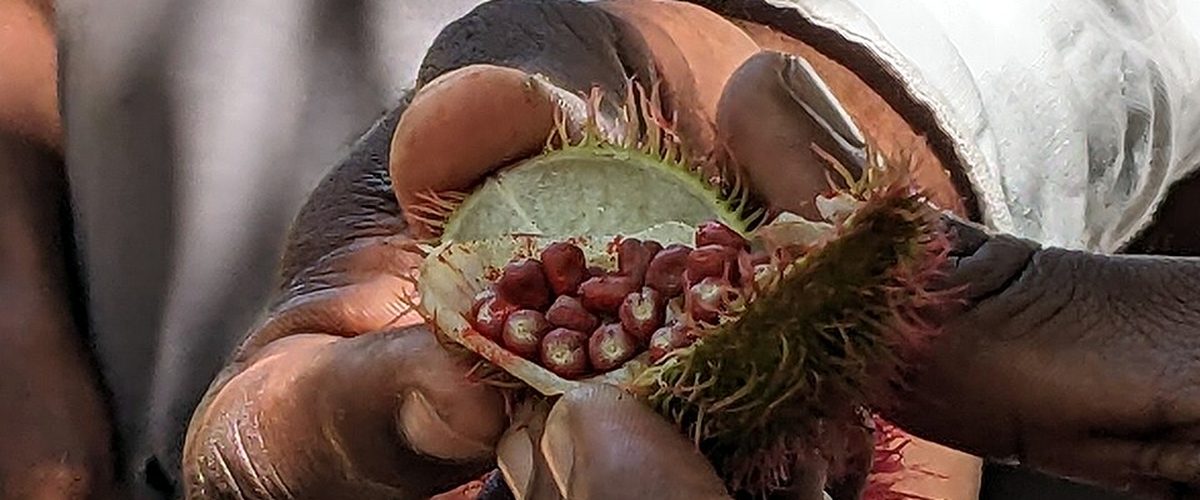
The moment everyone remembers is not a spice at all: it is annatto. The guide opens a spiny pod, crushes the red seeds inside and paints a vermilion streak on your hand. It is used as a food colouring and a dye; guides call it the lipstick tree.
From the lodge, allow half a day to a full day including the drive. One clear-eyed point: the global spice market has collapsed since the golden age, and some farms now earn more from visits than from selling their crops. That is no reason to skip it, but it is worth knowing before you buy.
What ends up on the plate
Swahili cooking carries all of that history. Pilau rice takes its colour and scent from cloves, cinnamon and cardamom. Fish curries combine coconut milk, turmeric and ginger. And masala tea, served everywhere, is simply another way of drinking the same plantation.