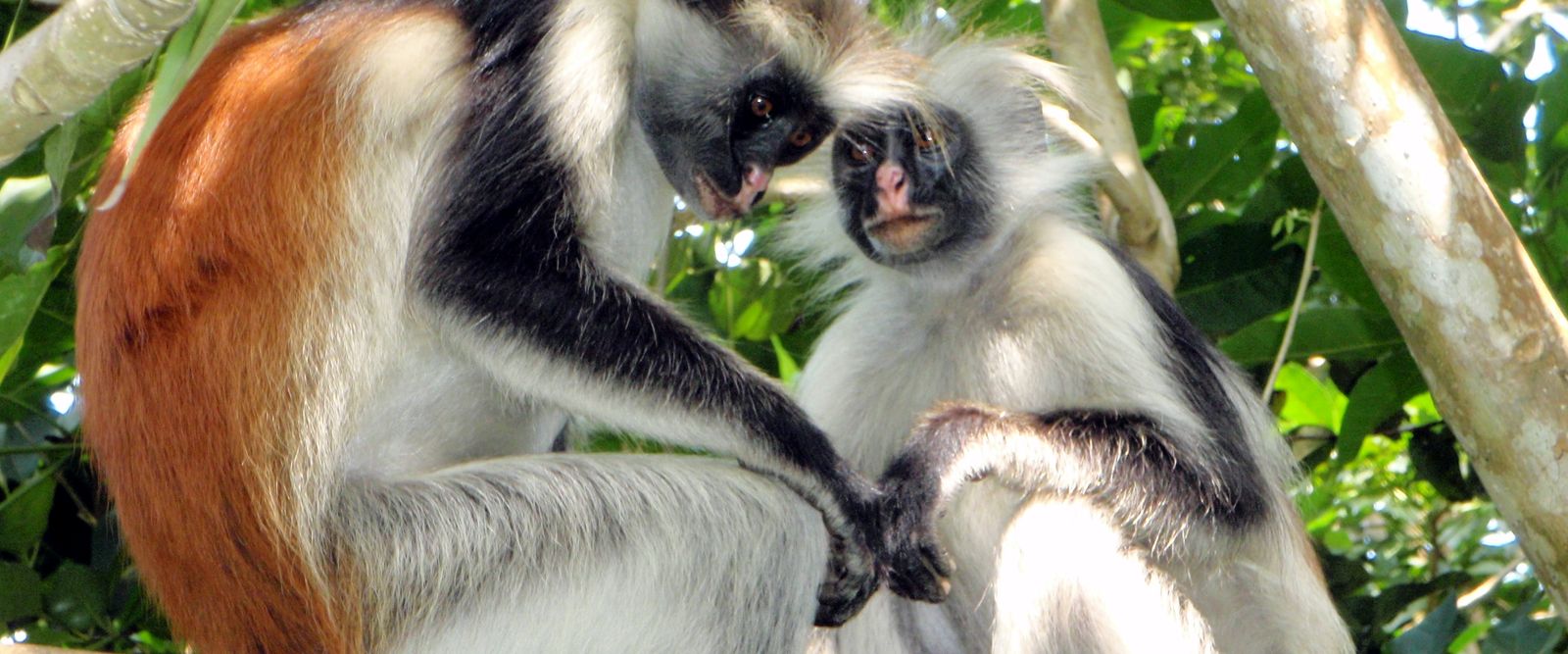
A monkey that exists only here
The Zanzibar red colobus, Piliocolobus kirkii, is endemic to Unguja island. Locally it is called kima punju. It is recognisable by its rust-red back, pale belly and the halo of white hair framing its black face. Like all colobus monkeys it has almost no thumb — an adaptation to life in the branches.
The complete census carried out by the Wildlife Conservation Society established a total population of around 5,862 individuals. Almost half live in Jozani-Chwaka Bay National Park, Zanzibar's only national park. The species is listed as Endangered on the IUCN Red List.
The south is part of its range
This is the part few visitors know: the species does not depend on Jozani alone. It also occupies a string of coral-rag forests running from the Kiwengwa-Pongwe reserve in the north down to Mtende forest, at the southern tip of the island.
In other words, the lodge sits inside the species' range. The monkeys seen passing in the morning are not a passing curiosity: they belong to an endangered endemic population.
The difficulty is that most of these forest fragments are small and lie outside officially protected areas, on an island whose human density exceeds 400 people per square kilometre. Less than two per cent of Unguja's surface is set aside for the conservation of native flora and fauna.
The threats, in order
- Habitat loss first: slash-and-burn farming, cutting building poles, charcoal production, property development.
- Fragmentation: groups isolated in forest patches too small to allow genetic mixing.
- Road collisions. At Jozani's southern edge, a road cuts through the home range of several groups. Four speed bumps were installed over roughly 600 metres, but the monkeys also cross outside that stretch.
- Crop conflict: colobus monkeys eat the bananas and cassava of neighbouring smallholdings, which long discouraged farmers from protecting them.
What is working
The colobus has been protected by law since 1919, but legal protection alone was never enough. Jozani-Chwaka Bay park was created through a participatory process, with the explicit aim that neighbouring villages receive a share of tourism revenue. Before that, communities watched the government collect visitors' money while the monkeys destroyed their crops.
The second lever is the zoning of community land, through community forest management agreements giving villages the mandate to manage their own areas. The colobus serves as an umbrella species: protecting its habitat protects everything living in it.
What you can actually do
- Never feed the monkeys, anywhere. A fed monkey comes close to roads and houses, and ends up run over or shot.
- Drive slowly on the Jozani road, especially at first light and late afternoon.
- Keep your distance: three metres minimum. Primates catch our respiratory diseases.
- Go through the national park rather than stopping at the roadside: the entry fee funds management and the villages.